Rigid Waveguide Tube Assembly About
Product Description
-
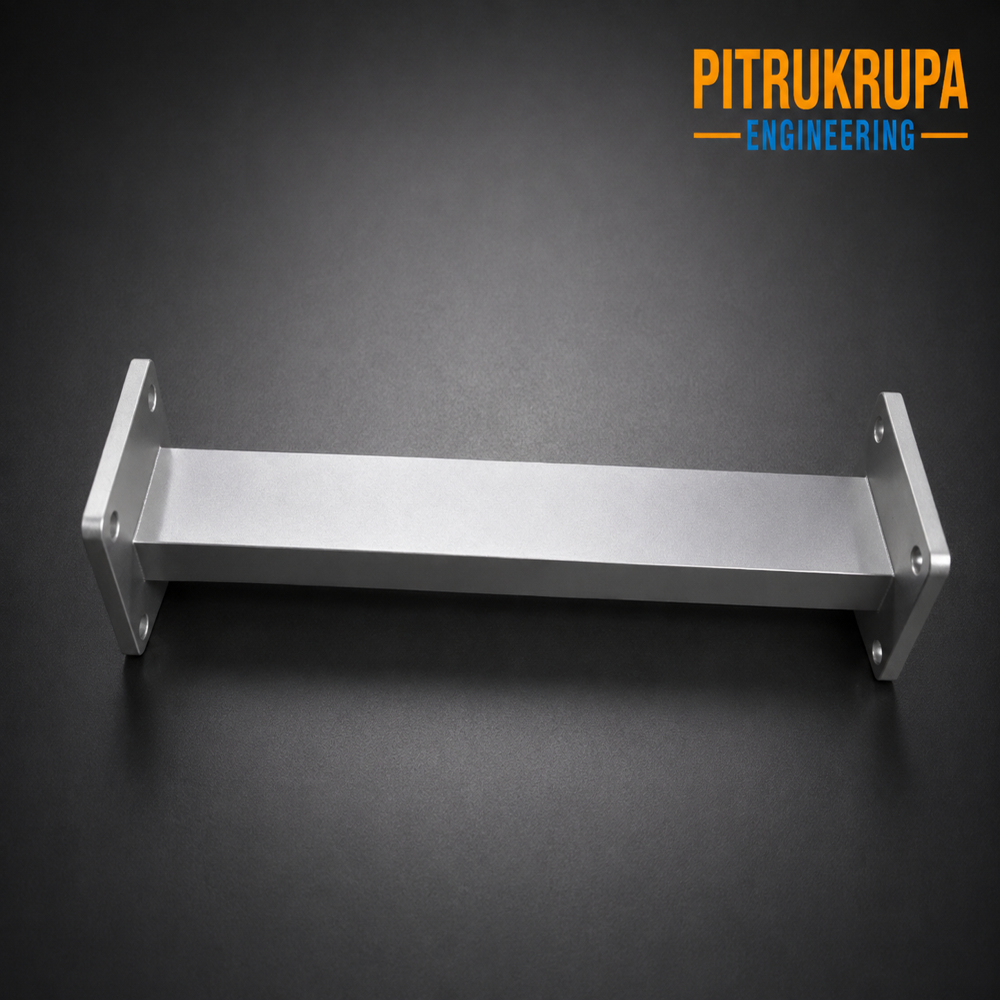
Item Name: Precision Rectangular Rigid Waveguide Tube Assembly / Double-Flanged Structural Support Bar
-
Manufacturer: Pitru Krupa Engineering (Ahmedabad, Gujarat, India)
-
Material: Typically fabricated from Aluminum Alloy (e.g., 6061-T6), Brass, or Stainless Steel.
-
Surface Finish: Fine bead-blasted satin matte finish or silver/chromate conversion coating for corrosion protection and electrical conductivity.
-
Key Features:
-
Dual Mounting Flanges: Rectangular end plates on both sides equipped with 4 precision-drilled corner mounting/alignment holes for secure bolt-down coupling.
-
Hollow Rectangular Profile: Rigid central body designed to function as a high-frequency RF/microwave waveguide channel or structural cross-brace spacer.
-
High Structural Integrity: Seamless end joins (welded or silver-brazed) ensuring airtight/signal-tight sealing and dimensional stability.
-
Applications: Satellite communications, radar system feedlines, RF microwave signal transmission, aerospace hardware, or precision machinery structural standoffs.
-
Precision Engineering for Reliable PerformanceOur rigid waveguide tube assemblies are crafted with high mechanical accuracy, achieving tolerances as tight as 0.02 mm. Each unit receives an anodized or polished finish, ensuring durability and longevity even when exposed to challenging environments. Designed for versatile mounting and supported by international standards, these assemblies are essential for advanced communication and radar projects.
Flexible Customization and Standards ComplianceWhether you need specific connector flanges or unique assembly lengths, we accommodate custom requirements to fit specialized applications. All assemblies adhere to leading international compliance standards, assuring quality and compatibility with existing systems. Our customer-focused approach supports both small and large-scale production demands.
FAQ's of Rigid Waveguide Tube Assembly:
Q: How does the rigid waveguide tube assembly ensure reliable performance in diverse temperature ranges?
A: The rigid waveguide tube assembly is designed to operate efficiently between -40C and +85C. Its anodized or polished surface treatment and precision mechanical tolerance safeguard structural integrity and electrical performance, making it suitable for both harsh and controlled environments.
Q: What are the customization options available for the connector flange of the waveguide tube assembly?
A: We provide customizable flange connector options to meet diverse operational requirements. Upon request, flange type, size, and configuration can be tailored to ensure seamless integration with your existing radar, communication, or test setup.
Q: When should I use a rigid waveguide tube assembly over flexible alternatives?
A: Rigid waveguide assemblies are ideal in scenarios where mechanical stability, minimal RF loss, and precision alignment are critical, such as radar, satellite communication, and laboratory testing. Opt for rigid tubes when your application demands fixed geometry and consistent impedance.
Q: Where can these assemblies be mounted and how is the installation process handled?
A: Assemblies are designed for through flange hole mounting, facilitating secure and precise installation on panels or equipment racks in radar stations, communication sites, and testing laboratories. The mounting process is straightforward, following standard mechanical practices.
Q: What is the typical process for ordering customized rigid waveguide tube assemblies?
A: To order a customized assembly, provide your specific requirements-including connector flange type, length, and any unique specifications. Our engineering team will confirm compatibility and produce a solution that meets both your operational and compliance needs.
Q: How does the 50 Ohm impedance benefit my application?
A: A standard 50 Ohm impedance matches most RF equipment, minimizing signal reflection and loss. This ensures optimal power transfer and consistent performance, which is particularly beneficial in demanding applications such as radar, satellite, and communications.

 Send Inquiry




 Send Inquiry


 Send Inquiry